Hello!
My name is Fernando Massa. I live in the city of Buenos Aires, Argentina, more than 11,000 km from Iceland. I am a journalist and screenwriter. In writing I found the place where my way of looking at the world and my vocation for storytelling intersect. I develop screenwriting projects and also work as a teacher — spaces where I continue exploring new forms of narrative. But my natural territory is the chronicle, and especially the travel chronicle: stories where experience becomes narrative.
Over the years I have come to know different corners of the world (including Antarctica!), but there is one destination that marked a before and after in my life: Iceland. Ever since, a postcard of its map has sat on my desk every day, as a reminder of how marvelous this planet can be and a commitment to never stop exploring it.
Some trips are planned around a natural attraction, a city, or local gastronomy. Others are built around a phenomenon. In Iceland, the northern lights function as that magnet that organizes itineraries, expectations, and even moods. Because, of course, it is not something that can be guaranteed: there are no schedules, no certainties. Only probabilities, patience, and one crucial element: clear skies. Perhaps that is why they are more than an attraction — they are an experience. And one you never forget.
In my case, the full spectacle took its time to arrive. It came on the very last night of a twelve-day trip.
The magical night
The weather forecasts indicated a high index for that night in mid-September. Jimmy Salinas, from Descubre Islandia — our guide for that magical night — confirmed it. He had already chosen the perfect setting for the aurora hunt: Thingvellir National Park, about 45 minutes from Reykjavík. An imposing place in its own right, with paths that cross cracks and fissures split open in volcanic rock, with walkways that skirt rivers and waterfalls, and where scenes from the fourth season of Game of Thrones were filmed.
Far from the city, the darkness was absolute. The temperature hovered around zero.
And then, suddenly, the sky.
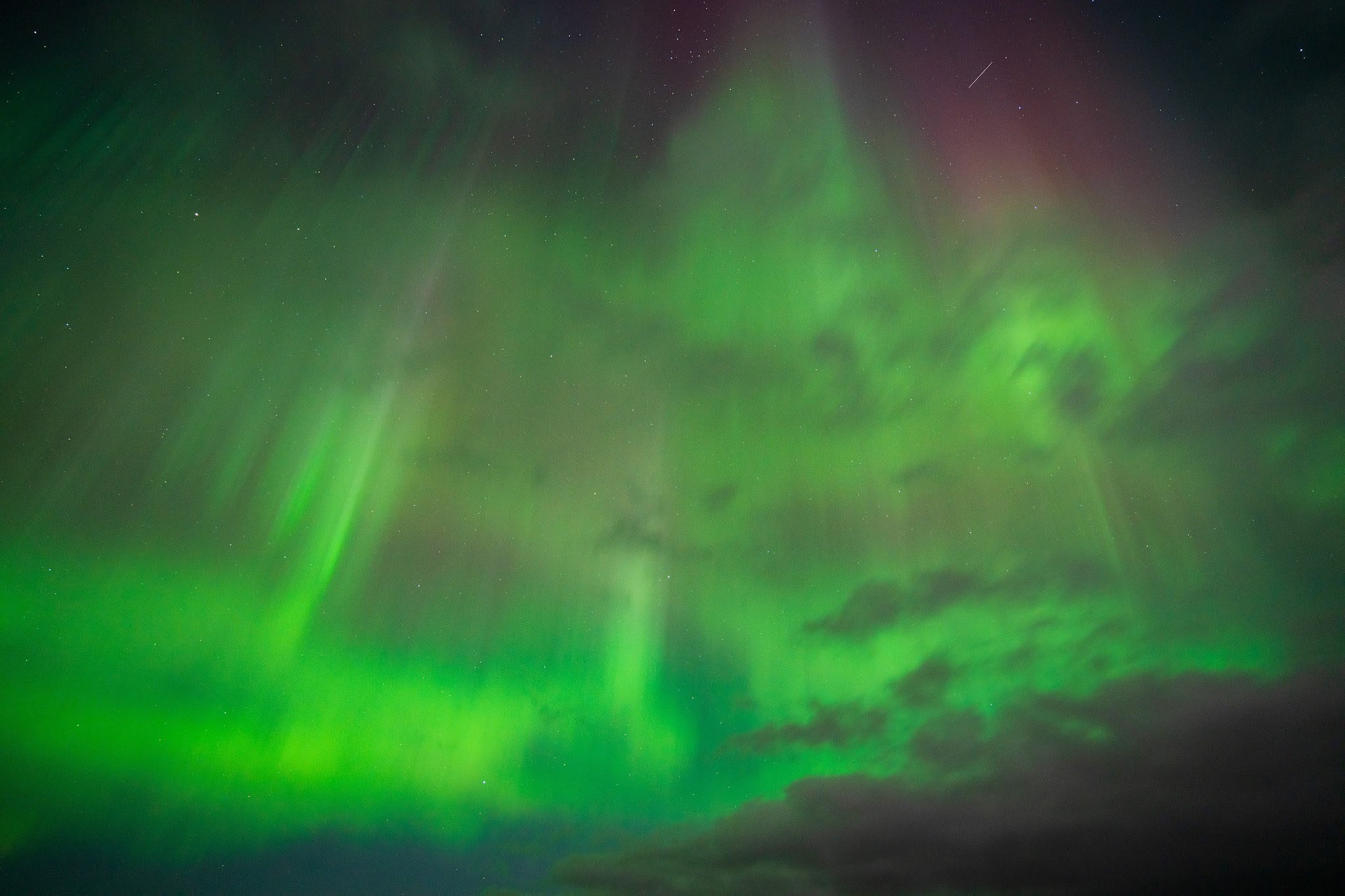
At first, timid. An iridescent green that appeared, faded, returned. Then bolder: flashes that stretched and moved, as if someone were painting in real time. "Wow," the group kept repeating. "No way, look at that." At one point, a kind of emerald crown opened above our heads, like a portal. The beams of light multiplied and cut silhouettes against the cliffs. In the background, only the constant murmur of water and the clicking of cameras.
The show lasted about twenty minutes. It faded. And then, a little later, it started again.
"The northern lights are like a sunset," Jimmy told me. "They're always different, always changing. You just have to be patient, wait for them."
What struck me most about the northern lights was their dynamism. Watching how in seconds they ignite, go dark, shift, reappear. It is a living phenomenon. And in that constant movement, there is something hypnotic.
Well into the early hours, when many had already boarded the bus waiting to head back, I decided to walk a little further away. I wanted to be alone. With my camera, a little wind, looking north. The Great Bear clearly defined, and a faint aurora forming here and there. It was a moment of absolute contemplation. One of those unforgettable moments.
I left full. With the awareness of having lived something extraordinary.
What are the northern lights?
I remember the first time I saw a northern light was many years ago in a Spanish film called Los amantes del círculo polar. There is a memorable scene where the couple watches a brilliant green aurora streak across the sky. At that moment I never imagined I would see them with my own eyes, or that I would come to understand scientifically what they are and why they occur.
Let's say that, in essence, the northern lights are the visible manifestation of what is known as space weather. They occur when particles from the Sun travel through space and reach Earth. Our planet is protected by the magnetosphere, a shield of magnetic fields that deflects most of that solar wind. However, in regions close to the poles, these particles manage to penetrate and collide with the atmosphere, specifically in the ionosphere, at between 40 and 120 kilometres in altitude.
When this happens, the atoms present — mainly oxygen and nitrogen — become excited and release energy in the form of light. That light is what I saw: the aurora. The colour, which can keep changing, depends on the type of atom and the altitude: green, the most common, comes from oxygen; red, blue, and violet tones come from nitrogen.
The intensity and frequency of auroras are also linked to the solar activity cycle. In periods of greater activity, the probabilities increase. Even so, two conditions came together for me that night in Thingvellir: darkness and clear skies. That is why winter in Iceland is ideal for finding northern lights. And it is worth having on your phone apps that track solar activity and anticipate possible appearances.
A universe of legends
In Iceland, every natural phenomenon has its own legend. For centuries, the northern lights were interpreted as signs, warnings, or presences. Spirits dancing in the sky. The luminous tail of an arctic fox crossing the snow. Promises of a good catch or omens of a storm.
Today we know exactly how they are produced. We can measure them, predict them, photograph them. And yet, when they appear, something of that magic remains intact. Perhaps because Iceland cannot be reduced to an explanation. And the northern lights are only one doorway into a universe unlike any other on the planet.